
|
There are many ways that I have come to know and work with grief and loss. One form that can be difficult to name is the grief connected to family estrangement.
When a relationship ends or becomes unsafe, the loss can be complicated. The people may still be alive, but the connection, care, or sense of belonging someone hoped for or once had, may no longer be available. This can be understood as ambiguous loss: a loss without a clear ending, which can make it hard to find closure. Estrangement can also bring grief for what never was—the support, safety, or understanding a person needed but did not receive. That grief may be overlooked because it doesn’t fit familiar ideas of loss. There may be no public ritual or shared acknowledgment, even though the impact is deeply felt. A trauma-informed perspective makes room for both the reasons a boundary may be necessary and the feelings that can accompany it. Choosing distance to protect one’s well-being does not mean the relationship was unimportant, or that sadness and longing will disappear. A person can recognize the harm, maintain a boundary, and still grieve what has been lost. Resilience does not require minimizing that grief or turning it into a lesson. Sometimes it begins with naming the loss, respecting the needs that led to a boundary, and allowing more than one feeling to be true at the same time. Family estrangement is often discussed in terms of choice. It is also worth recognizing the grief that can exist alongside that choice.
Grief related to family estrangement—grieving relationships and care that are absent, even though your family members are still alive is not something that everyone can relate to. In my professional practice supporting families through death and dying, I have stayed with the dying parent who had been abusive to their family. When the time comes to offer palliative care, or say goodbye, the abusive parent might face death alone. My bedside vigil might be the only company or care offered separately from the health care system. When my parent was injured in a motor vehicle crash, I was shamed for not taking that parent in and caring for them. I was shamed before that, when it was determined that parent could not live on their own anymore and I refused to open my home. The family members who spent time and energy trying to appeal to my sense of responsibility didn't know that I had already spent several years, a decade before, trying to create a plan with my aging parents. Neither one could be bothered with the discussion and became annoyed with my constant attempts to begin discussions. My sibling asked me a question that I had yet to internalize. "Why do you care so much? You are worrying about their end of life more than they are." My relationships with my parents have been difficult and damaging, and contributed to me experiencing homelessness throughout my life, though the first time I was 12. I was often portrayed to my extended family as a problem child, but no one seemed to understand what was happening behind closed doors. I have never publicly shared the details of what happened, and I don’t intend to. Keeping those stories private is what feels right for me. I recognize that others may choose to share their experiences, and that choice is theirs to make. For me, sharing the details would not be helpful. I’m not interested in seeking revenge or punishing anyone. By focusing on healing and breaking cycles, I can focus on what I’m able to change and improve for my family and community. Still, the effects of this estrangement—and the well-being I’ve found since I stopped allowing these harmful relationships to dominate my life—cannot be ignored. In my chapter in Tender Truths: Caring for the Dying, I wrote about growing up feeling suicidal and experiencing suicidal ideation as a coping mechanism, well into adulthood. That was my normal for a long time. When I was diagnosed with Complex-Post Traumatic Stress Disorder at the age of 32 I began to finally understand how unhealthy I had become. Breaking free from unhealthy friendships and family relationships became essential to building a happy, successful life and finding peace. When I share elements of this personal story in my Indigenous Death Worker training, I can feel when it resonates with someone in the room. Unfortunately, there is always someone who can relate—someone grieving the past and how it has shaped their present and future. I grieve that my family never truly got to know me and only ever knew me in survival mode. I grieve that the people I thought I was closest to never truly saw me as a person, but instead as an extension of themselves and a way to meet their own needs and wants. When I look back at how hard grieving these last seven years of estrangement has been and consider how much I miss my family, I don't miss how they treated me and I never will. I do love them and hope they do well, no matter how far apart we may be. As a death worker, I will continue to show up for people who are estranged from their families as they approach death. Estrangement can have complex histories, including abuse, and I won’t assume what a person needs or pressure anyone toward reconciliation. I will offer presence and advocate for compassionate care that reduces harm for the person who is dying and for those affected by their choices. As recognition of death workers grows, we must also recognize the value of this work: meeting people with care, without judgment, when family relationships are complicated or absent. Choosing no contact to protect yourself doesn’t make the grief less real, and grieving them doesn’t mean your boundary was wrong.
0 Comments
Reflecting on the value of working with a group of community caregivers after completing a three-day training on the Six Nations of the Grande River First Nation. The case for designating caregiving as a recognized trade in Ontario and provinces across the country is compelling, both from economic and social perspectives. Caregiving is widespread in families and communities, for loved ones and as a low barrier employment path for people entering the workforce. In every family and every workplace, we can find caregivers sitting at every table, every elevator ride and every doctor appointment. Paid or unpaid, caregivers make this world possible.
Currently, thousands of caregivers across the province provide essential services without formal recognition, standardized training, or adequate compensation. By establishing caregiving as a recognized trade, Ontario could address several critical challenges in its healthcare system while creating valuable economic opportunities. First, trade designation would establish standardized training and certification programs, ensuring consistent quality of care across the province is accessible and sustainably funded. This would include comprehensive education in essential caregiving skills, health and safety protocols, and specialized care techniques. Such standardization would not only improve care quality but also provide caregivers with recognized credentials that validate their expertise. Second, formal recognition would enable caregivers to command fair wages commensurate with their skills and responsibilities. Unlike Skilled Trade Workers, full time Personal Support Workers and care workers either receive minimal compensation or provide care without pay. Trade status would establish clear wage scales, overtime provisions, and benefits packages, helping to professionalize the field and attract more workers to address the growing demand for care services. Third, trade designation would create clear career pathways and opportunities for advancement. Caregivers could pursue additional certifications, specialize in specific areas of care, or advance into supervisory roles. This career ladder would help retain skilled caregivers in the field and create a more sustainable workforce. Fourth, recognizing caregiving as a trade would facilitate better regulation and oversight of care services, protecting both caregivers and care recipients. It would establish clear standards of practice, ethical guidelines, and mechanisms for addressing concerns or complaints. Now is a time that we should all be thinking about creating the care options that are equitable and sustainable. Finally, trade designation would acknowledge the significant economic contribution of caregivers to Canada's healthcare system. By formally recognizing their work, the province would be better positioned to develop policies and programs that support this essential workforce while ensuring sustainable, high-quality care for Canada's aging population, as well as opening doors to create an infrastructure of support to caregivers for vulnerable people living with disabilities. The implementation of such a designation would require collaboration between the Minister of Labour, Training and Skills Development, healthcare institutions, and existing caregiver organizations. However, the potential benefits - including improved care quality, better working conditions, and a more sustainable healthcare system - make this a worthwhile investment in Canada's future. Long-gone are the parades and supportive attitudes for the front-line workers. It is back to business and we are once again forgetting the people who offer society the most yet receive the least in their bid to simply exist while providing care for others. Join me in calling for Caregivers to be added to the official Skilled Trades List. Imagine working as a birth or death doula, as a daycare worker, or home aide worker, and suddenly your training and work is valued by the place you live? Imagine if your local rural doctors office suddenly employed birth and death workers? What could be possible if the local YM/WCA suddenly had on-staff PSWs who could offer care and connection with community supports when an individual or family transitioned into a new home or community? What if that patient being discharged from the hospital to die at home had even more support and care because your workplace has hired death workers? The value for Caregivers in community must be remembered, valued and upheld. Let's teach our children and future generations that we appreciate caregivers and what they do for our communities. The Helpers Oath of CareI will empower individuals to feel safe and supported when facing life changes. I will work as a listener. I will practice reflection if I cause harm without intention. I will practice wisdom and empower others to make choices about their own care. I will be the caregiver and helper when asked and promise to do no harm. Care for Caregivers/Care for MyselfWords are powerful. I will use my voice and my words with care.
I won't be afraid to ask for and receive support for myself and prioritize self-care. I will be the caregiver and helper for myself and define harm reduction practices that empower me to continue to offer care. a reflection written by Chrystal ToopThis past Friday, October 4th marked the 20th annual Families of Sisters in Spirit Vigil to honour Missing and Murdered Indigenous Women, Girls and 2SpiritLGBTQQIA+. This somber day has always been for families and friends, in and around Ottawa, to flood Parliament Hill holding enlarged photos of loved ones with their names. This movement began with a seemingly small action to show the outside world that we have not forgotten our missing and murdered. When Bridget Tolley’s mother Gladys was murdered, her search for truth and justice led her to Parliament Hill, photo in hand. Sadly, the necessity of this day has not diminished, but amplified. To commemorate a 23rd year of her search for accountability, Bridget cut and burned her hair in a ceremony, with help from her great grandchildren and supporters. Nations across Turtle Island have different teachings about the sacredness of hair. The ceremony of cutting hair represents the significance of a loss. Whether you cut your hair to honour someone in death, or to honour the grief you carry for the loss of your safety, the practice of growing and braiding hair to cut off is a ceremony of reflection and release. Each day Indigenous women and girls grow up knowing they are overrepresented in correctional and child welfare institutions, missing and murdered statistics. This day is a protest of no more stolen sisters. This day is a necessary movement to shout, in the first world country that is Canada, we are not expendable or invisible. Indigenous women matter. Like most First Nations, Inuit and Metis people I carry my own stories of grief and loss and have attended many, many Sisters in Spirit Vigils over the years to honor people who impacted my life and were taken away in tragedy. On this day, I was accompanied by loved ones to the Hill and this was a form of safety planning. This was one way that I could try to offer myself care and harm reduction, during and after what I knew would be an emotionally difficult afternoon. Even though we ended in ceremony with the day’s vigil, I began to formulate a plan for more self-care and wellness. As a tattoo revivalist, ink sessions are one way to practice my ancestral spirituality. I chose to end this solemn day of mourning in a good way, by receiving clan marking with my family. This healing way we have with lots of laughter helped to carry us from the bittersweet reunions with others in this movement, all the way home that night. #NoMoreStolenSisters #SistersInSpirit
Recently, I was a guest speaker for a class at Nipissing University. The class is Death, Dying and Spirituality in End-of-Life Care.
Taught by my friend Susan Srigley, of the awesome Death Ambassadors and Nipissing University, this course has been a symphony of human rights, compassionate reflection and practice building. It has been a pleasure to see this class of future helpers grow and seize their own way forward to support death and dying. Emerging from this cold season has brought all the things to the surface. I am grateful for the time spent gathering winter medicines. Taking this course and having the stress free experience of studying and learning has been the winter medicine I needed to help me dive into each Monday with a plan. Speaking to students is always a privilege and the stories I share from my bundle have come from a lifetime of lived experiences from generational impacts. It is an honour to share time with students and something that I always look forward to. 2023 began with a bang of excitement and activity and the response to this business I call my heartwork continues to leave me awestruck.
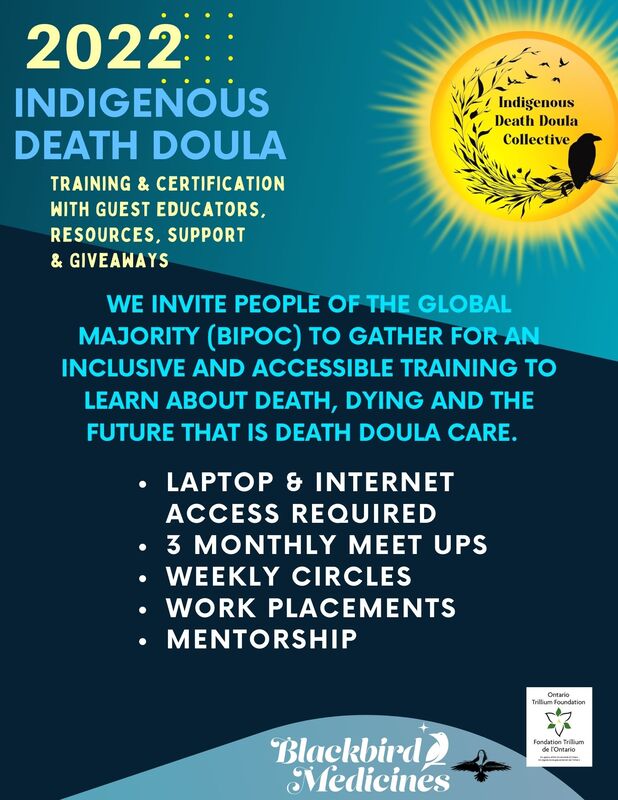
Perhaps you have been following along with this blog as someone interested in completing the Indigenous Death Doula training program. Maybe you have attended one of the public speaking events or virtual workshops offered where I was invited to talk about Indigenous death, dying, loss and grief.
This work is an area where I have cast my heart, countless hours spent curating an offering to Indigenous caregivers that I had promised way back in 2020. Foolishly, I thought I could drive deadlines and tasks to completion like I do with everything else. This training is more than a program, it is an offering of care to Indigenous people everywhere. I thought obtaining funding would mean we could bring this training into reality and while this truly did make a difference, it was only one aspect of creating this community experience. Now, with the training close to launching, I am moved by all the teachings I have added to my bundle. What an experience this has been. I found myself mourning while working on the training's content. This past year, my uncle and aunts departed from this world. Some of these relatives felt more connected to me than others. This too was cause for reflection as I answered queries about education for the dying and coping with grief. I worry about missing out on moments of connection with the generation before me. Do they know how grateful I feel for the unconditional love they gave me? With all of these deep pensive moments, I was surprised to find myself pregnant. A welcomed surprise, my husband and I were ecstatic to learn we were expecting and before long we had vitamins ready, names picked out and a doctor's appointment scheduled. In our excitement, we shared our news wide and far. We told our families, our workmates, our favorite taco restaurant staff. Our joy was short-lived and I will never forget the moment I understood that a miscarriage had taken place. My doctor was, and always is, amazing. I wish everyone could have a doctor like I her. She expressed her condolences and bolstered our broken hearts by sharing statistics (we are research-loving, data people) and encouragement to begin trying to conceive. Getting pregnant at all was a confirmation of our fertility. Armed with a positive outlook, I tried my best to carry on. Helpers reached out with their messages and teachings from ancestors, enveloping me and my family in love. Despite the teachings I carry in my bundle about reproductive health, mental wellness and healing, none of this insight seemed to relieve me of my grief. Here I was working away at creating tools to support others coping with loss, simultaneously struggling to find solid ground in the wake of losing our baby, of losing my uncle, and then my aunts, and the vibrance they brought to our family. I felt the weight of multiple losses, compounding on my shoulders and in my heart. What truly helped disperse the clouds and helped me cope was the many lovely friends and family who took a moment to share stories of their own pregnancy losses. What a terrible club to belong to, yet I am so grateful to each and every person who took a moment to disclose their membership and mirror what we were going through. All at once, I understood the journey that creating this training had become. By connecting and supporting each other, there is always care and love to get through the darkest times. Even though this training has taken far longer to launch than anticipated, I am excited to invite the previous Indigenous mentees to form the first cohort in time for Summer Solstice. A humble offering from my laptop to yours, with the help of many, many incredible knowledge carriers will arrive just when it's meant to. chii miigwetch for reading, sharing and commenting.
It seems like an easy enough question. For most First Nations, Inuit, and Metis people this is a question that we have come to expect from new faces that also belong to these communities.
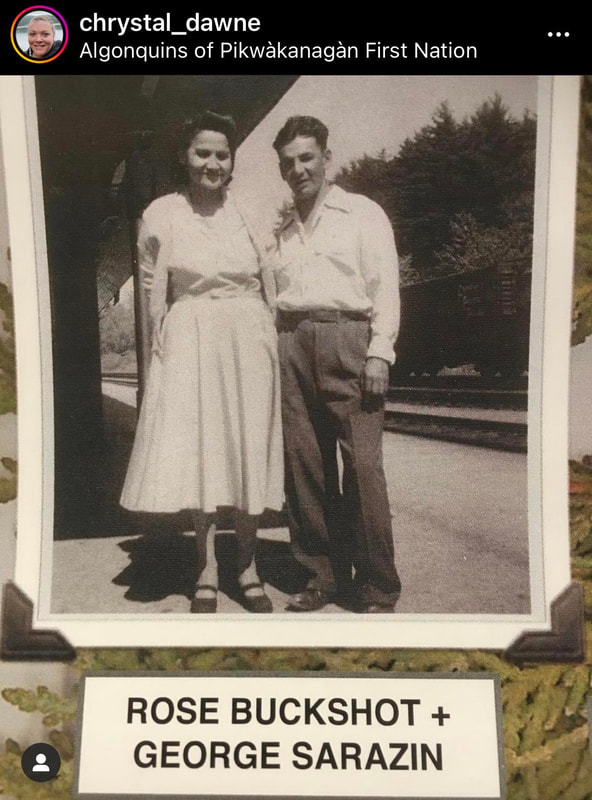
Who claims you? This question once made me stammer out the word Pikwakanagan and it took memory games to help me remember the proper way to share the name of the community on my status card. Eventually, I would become known to some people from my ancestral community and I am proud to claim my mother and grandfather's name Sarazin, his mother's name Buckshot, her mother's name Lemure, and her mother's name Pessindiwate, and her mother's name Whiteduck. Today, I am proud to know the names of 14 generations of my Algonquin grandmothers. It is not knowledge I always possessed and their names are part of my ceremonies and the guidance I know is with me, through everything on this journey. Where do you come from? A question that was infinitely harder for me to answer as I later learned that my life had been formed in transit, never living more than five years in one place. Two years here, one year there, oh-time to move again. I became vague in my response and told people I had grown up between Thunder Bay, Montreal and Ottawa. I didn't care to explain all the small towns I had grown familiar with in my one, two and five year stints. All of the small towns in northern Ontario like South Gillies, Manitouwadge, Caramat, Mattawa, and eastern Ontario places such as Winchester, Oxford Mills, Russell and Kemptville. These places didn't remember me and some I tried to forget. It was easier to explain my life when I said I was a city girl. My time in cities had consisted of bouncing from one parent's home in Thunder Bay or North Bay, to the other's in Ottawa. In Thunder Bay I attended high school for grade eleven and managed to pick up an English credit for grade 12. Who are you? It's a question I haven't always known how to answer and when I did, there seemed to be intricacies that I wasn't aware of. There were teachings I was missing and it showed. The first time I met someone else from my community, it was in Toronto and she was not impressed. She taught me that I couldn't say I was 'from Pikwakanagan' because I had never lived there. She was harsh and she was right. I was from so many places and nowhere, all at once. If you are supposed to answer the question of who are you by acknowledging the place that you are from, I didn't know where to start. Eventually, I would answer this question by moving back to where my mother's family was from. Generations of my grandparents' relatives have been married and buried where I too was married, and one day will be buried. Who is your family? When I worked at KAIROS Canada, this question was posed to me by other Indigenous people I encountered. "Who is your mother?" An Inuk Elder asked. She wouldn't know my Algonquin mother, but I answered the question anyway, as I had learned to do, without hesitation. When she asked me again a few hours later, I felt annoyed but answered again. Over and over this woman interrogated me and I found myself wondering at her motivation. There are many raceshifters who have found success and acceptance in faithful spaces. When I think back, I am happy to know this question is being asked by these Elders, with insistence and relentlessness. It doesn't matter what compels someone to ask, it is my responsibility to always answer and I do, each and every time. This accountability is a teaching I carry and share. These are the questions I ask when someone presents themselves as First Nations, Inuit, or Metis and express interest in working with me. And I also expect an answer. If someone wishes to occupy space as an Indigenous person, they should have no problem answering questions. A person should have no issue with me asking my contacts from the community you claim to belong to, in order to confirm you are who you say you are. Today, I found myself reflecting on the ways I have practiced accountability and the moments where collaborators on my path have not practiced this same value. Visit this archive to learn more about me and my journey, the works and collaborations I've enjoyed being a part of and birthing into life. Chrystal 'Waban' Toop Archive This past weekend has been difficult for many and I am no exception to this. The Freedom Convoy made it's way through my community and onward to Ottawa. Once there, this group was reported on by many bystanders for waving symbols of racism, openly breaking laws and bylaws, and mocked First Nation drummers and singers by chanting and banging drums. While I won't get into the problems of this movement, or why it's not okay to support social action taken in support of racism, I do want to discuss something I come across often in my different fields of work.
Cultural appropriation is not respectful practice. Imitation is not always a form of flattery. Time and time again, I find myself in specific training around funerals or end-of-life practices and these trainings are facilitated by white death workers. I am always shocked at the ease with which these practitioners culturally appropriate ceremonies to offer in their private practices. As a First Nations-mixed woman with white privilege, I am particularly sensitive and aware of the importance of positionality and community recognition. It is common for me to provide proof and verification of my community connections with the Algonquins of Pikwakanagan First Nation and this is something anyone who IS actually First Nations, Inuit, and Metis has the ability to grasp. In death work, many of my peers find no problem with smudging, carrying sacred items and practicing their own version of cultural ceremonies. I've heard the decision to use these traditions validated and quantified by white practitioners in all sorts of ways. The most common justifications are: 1. I learned these from an Elder/Teacher who gave me permission to use these practices. Elder/Teacher has passed on and claims are not verifiable. 2. It's okay, I have Indigenous ancestry. 3. I only do it for people at end-of-life, when it brings great comfort. The reality is that these justifications are massive red flags of cultural appropriation. For each of these harmful end-of-life care providers, there are as many working to center voices of Black, Indigenous, People of Color in ways that are meaningful and impactful. By speaking out against these moments of cultural appropriation, they are practicing allyship in an important form. Cultural appreciation is practiced by allies who insist on an actual First Nations spiritual practitioner or end-of-life doula being engaged and compensated for their knowledge, time and travel. Here are some helpful strategies when practicing allyship around end-of-life care. These tips are widely applicable to many situations and I am always happy to engage in discussions that promote and center the good steps taken by allies looking to do better. 1. Hire a First Nations, Metis, or Inuit death doula, counsellor, cultural practitioner to facilitate healing, ceremonies, and rituals like talking circles, smudging with traditional medicines, or drumming and singing. Blackbird Medicines is comprised of numerous First Nations spiritual practitioners, teachers, helpers, singers and drummers. We are always happy to provide these services and have many options available, regardless of cultural background and will ensure your end-of-life arrangements are respectful and appropriate. 2. Ask for community references from the Indigenous community. A letter from a federally recognized First Nation or Friendship Center are great. Blackbird Medicines offers genealogical services at an affordable cost for people who are seeking information on their background and will provide a letter of support regarding validated genealogical claims. 3. Ask for genealogical background. A general and vague association with a single or many communities is a red flag. Blackbird Medicines offers genealogical services at an affordable cost for people who are seeking information on their background and will provide a letter of support regarding validated genealogical claims. If you need additional resources, please don't hesitate to reach out. We can all use help to do better when moving forward. You may have heard me speak or read something written by me where I spoke about training to become an Indigenous Full Spectrum Doula.
You may have heard about Doula work and the important impacts this role is having for families and health care navigation. I'm excited to be a part of the Cornerstone Birthwork Training team with Capstone Canada. This training is fullsome and radical-two of my favourites qualities. Sign up for this year's first cohort and learn what's in your Doula bag. REGISTER HERE: https://cornerstonedoulatrainings.teachable.com/p/capstone-canada-feb 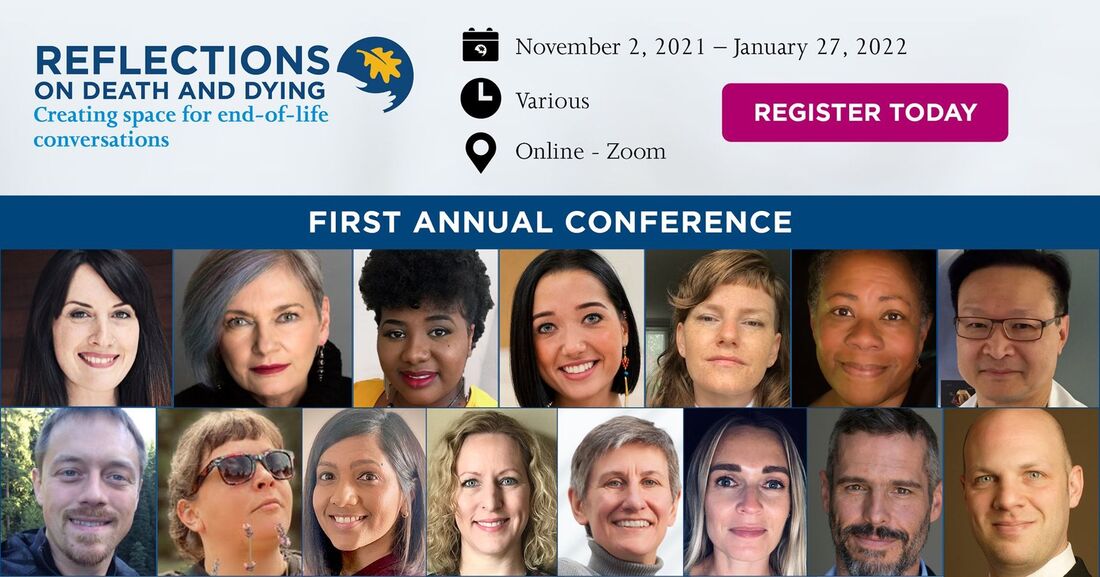 Recently I was honoured with an invitation to present at the virtual conference Reflections on Death and Dying: Creating Space for end-of-life conversations.
I was nervous to address this audience and this is far from typical for me when speaking in public. How many people would sign up? Would the words I share resonate? How would I be received when I started in on systemic oppression and capitalism creating harm and trauma for people? As the attendee count climbed past 120, and higher, my nerves began to abate. Idling at 188 participants, the organizers decided to start and began to introduce me by reading my bio. The bio is always too long and I find myself making mental notes to trim it back and before the thought can land, I am bolstered at my own history. I've survived so much and that is exactly what I am here to talk about. Indigenous people have survived so much, to enjoy this privilege of life and I'm going to begin this mostly one-sided conversation with my ancestors on my shoulder. They are guiding me in this sharing and so I take a deep breathe. I begin. |
About ChrystalMy name is Chrystal Toop and I am a member of the Algonquins of Pikwàkanagàn First Nation and am Anishnaabe, French & Polish. Archives
November 2026
Categories |


 RSS Feed